
How to Choose a Software Company: A Practical Checklist
The best software company for your project is the one that can show real work, hand you your code, build properly in Arabic and stay after launch. Here is how to check each of those before you sign.
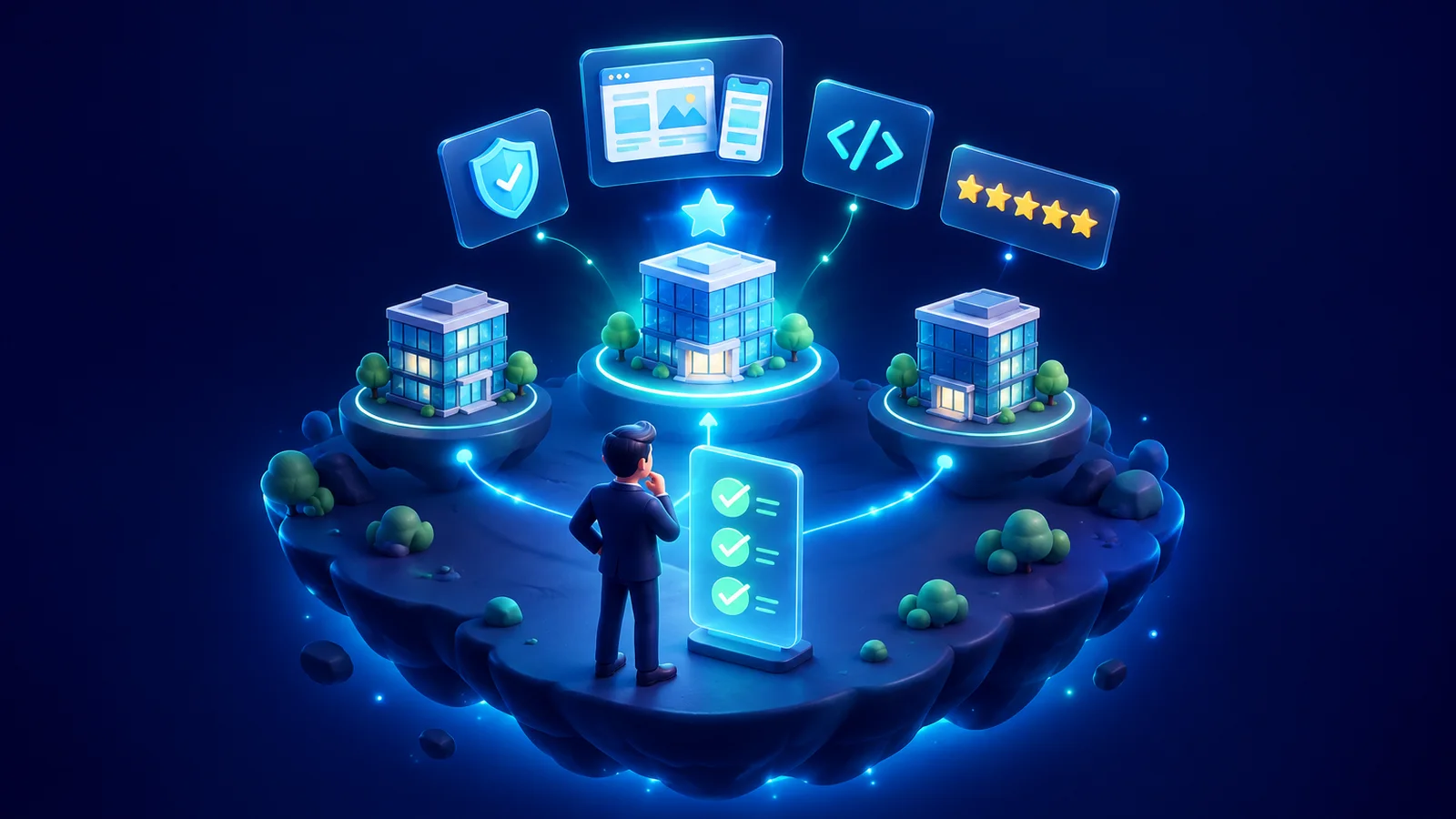
To choose a software company, check six things before you sign: real projects you can open and use, public reviews from named clients, a contract that gives you the source code, proven Arabic and right-to-left work, a clear process with regular demos, and a written plan for support after launch. A company that is strong on all six is a better choice than one that is simply the cheapest or the most famous.
Searching for the best software company in Saudi Arabia, the UAE, Kuwait, Türkiye or Syria returns hundreds of agencies with similar websites and similar promises. The checklist below helps you tell them apart with evidence rather than impressions. It works whether you need a mobile app, an online store, an educational platform or an internal system.
Check real projects and public reviews
Open live projects, not just a portfolio page
A portfolio of polished screenshots proves that someone can design. It does not prove that the software was launched, used or maintained. Ask for projects that are live today, then open them yourself.
- Download the apps from the App Store and Google Play. Read the update history and the store reviews.
- Open the websites on your phone, switch to Arabic and try a real task such as searching, registering or checking out.
- Ask which parts the company built: the whole product, only the app, or only the design.
- Ask for one or two clients you can speak to, ideally in your sector or your country.
Projects similar to yours matter more than famous logos. A company that has built several booking or e-commerce products already knows the problems your project will meet.
Read reviews on Google and Trustpilot
Reviews on independent platforms such as Google Maps and Trustpilot are harder to manage than testimonials on a company's own website. Read them for detail, not just for the star rating. Useful reviews mention a named project, describe what was delivered and say something about how problems were handled.
Look at the dates too. A steady flow of reviews over several years says more than a burst of five-star ratings in one month. A company with a few honest, detailed reviews is often a safer choice than one with many vague ones.
Make sure you will own your code
Code ownership is the clause that buyers most often skip and most often regret. If the company keeps the source code, you cannot change suppliers, hire your own developers or even move your hosting without its permission.
For a custom project, the contract should say that the source code, the cloud and hosting accounts, the app store listings, the domain and the documentation belong to you and are handed over in your name. Ask where the code is stored during the project and whether you can have access to the repository from the start.
Ready-made platforms work differently. They are usually licensed, not sold, so you pay for the right to use them under your brand. That is a fair model when it is stated clearly. Ask what happens to your data if you leave and whether source access is available.
Test their Arabic and right-to-left competence
Many agencies say they support Arabic. Fewer build products that feel native in Arabic. Right-to-left layout is not a mirror image of an English design: icons, numbers, mixed Arabic and English text, dates, forms and search all need deliberate decisions.
- Ask to see the Arabic version of a live product, not a mock-up.
- Check that menus, arrows and progress bars run in the correct direction.
- Type a mixed sentence such as an Arabic product name with an English model number and see how it displays.
- Check that Arabic search finds words with and without diacritics and with different forms of the letter alef.
If the Arabic version feels like a translation added at the end, your users will notice.
Process, security and support after launch
How they work and communicate
Most failed projects fail through poor communication rather than poor coding. Before you sign, ask the company to describe a normal week on your project.
- Is there a written scope that both sides sign before development starts?
- Will you see working software regularly, through demos and a staging link you can open yourself?
- Who is your single point of contact, and in which language and time zone do they work?
- How are changes to the scope requested, estimated and approved?
A good answer is specific. 'We are agile' is not a process. 'You get a demo every week and a test link you can use at any time' is.
Security, quality and support
Your software will hold customer data, payments or internal records. Ask how the company protects them. Certifications such as ISO 27001 for information security and ISO 9001 for quality management show that a company runs documented, audited processes. They are not a guarantee, but they are a meaningful signal, and you can ask to see the certificate and its scope.
Then ask what happens after launch. Apps need updates when Apple and Google change their operating systems, servers need security patches and your team will want new features. Ask whether there is a monthly support plan, what it covers and whether the same team that built the system will maintain it.
Ready platform or custom build?
Not every project needs to be built from scratch. If your needs match a common model, such as an online store, a learning platform, a property portal or a donation site, a ready platform launched under your brand can get you to market faster and with less risk. If your process is unusual or is the core of your competitive advantage, custom development is usually the better investment.
A trustworthy company will tell you which option fits your case, even when the answer is the smaller project.
Red flags to watch for
- A fixed quote given before anyone has asked about your users, roles and integrations.
- No live projects you can open, or projects that turn out to be someone else's work.
- Vague answers about who owns the code and the accounts.
- Promises of guaranteed downloads, sales or first-page rankings.
- No written scope, no demos until the end, and no named contact.
- Silence about what happens after launch.
Frequently asked questions
What is the best software company in Saudi Arabia or the UAE?
There is no single best company for every project. The best choice for you is the company with proven work in your type of product, good independent reviews, clear code ownership, real Arabic competence and a support plan after launch.
Should I choose a local company or one based abroad?
What matters most is whether the team understands your market, works in your language and time zone and has delivered for clients in your region. Many Gulf companies work successfully with teams in Türkiye and elsewhere in the region.
How many companies should I compare?
Three is usually enough. Give each the same written brief so you can compare their questions and proposals on equal terms.
How Vega SDS works
Vega SDS is a software company with offices in Istanbul, Türkiye and Sharjah, UAE, working since February 2021 with clients in the Gulf, Türkiye, Syria, Iraq, Jordan, Europe, Canada and the USA. The company is ISO 9001 and ISO 27001 certified. Every project starts with a written scope, runs in short sprints with regular demos and a staging link you can open any day, and ends with a documented handover. For custom projects, the source code, accounts, documentation and store listings are handed over in your name. Vega also runs five ready platforms for education, e-commerce, real estate, mobility and donations, launched under the client's brand in 2 to 4 weeks. Most clients stay on a monthly support plan, maintained by the team that built their system. Client reviews are public on Google and Trustpilot. These are the highlights; you can read more about each service and project across the site.